How to Choose the Best Silicon Carbide Semiconductor for Your Needs?
Choosing the right Silicon Carbide Semiconductor is crucial for various applications. Experts in the field emphasize the importance of this decision. Dr. Emily Chen, a leading researcher in semiconductor technology, once stated, "Selecting the right material can make or break your project's success."
Silicon Carbide Semiconductors are known for their high efficiency and thermal performance. They outperform traditional silicon counterparts in many scenarios. Specific applications, like electric vehicles and renewable energy systems, showcase their unique advantages. However, the options can be overwhelming. Factors like voltage ratings, thermal conductivity, and cost must be assessed.
Evaluating different manufacturers adds another layer of complexity. Some companies excel in innovation while others offer reliability. Not all products are created equal. Understanding the intricacies of Silicon Carbide technology can lead to missteps if you rush the process. Careful analysis and expert consultation are necessary to truly harness the potential of Silicon Carbide Semiconductors.

Understanding Silicon Carbide Semiconductors and Their Benefits
Silicon carbide (SiC) semiconductors have gained significant attention in various industries due to their unique properties. These materials offer superior performance compared to traditional silicon-based semiconductors. They can withstand higher temperatures and voltages, leading to enhanced efficiency in power electronics. This makes SiC ideal for applications in electric vehicles and renewable energy systems.
Moreover, SiC semiconductors contribute to energy savings, particularly in high-power applications. Their lower energy losses translate to reduced heat generation, which can minimize cooling requirements. However, manufacturers must consider the specific needs of their projects. Not every SiC option will fit every application perfectly. Understanding the unique requirements of your application is essential.
Challenges arise when selecting the right SiC component. The wide variety of options can be overwhelming. It's crucial to research and understand the specifications for your particular use case. Seeking advice from industry experts can help navigate these complexities. Balancing cost, performance, and reliability is a delicate task. Each decision must be made with careful consideration of the long-term benefits and potential drawbacks.
Key Factors to Consider When Selecting Silicon Carbide Semiconductors
Selecting the right silicon carbide (SiC) semiconductor is crucial for optimal performance in various applications. The first factor to consider is the voltage rating. SiC devices often support higher voltages, up to 3,000 volts, making them suitable for power electronics. This feature is particularly beneficial for electric vehicles (EVs) and renewable energy systems, where efficiency is crucial.
Another vital aspect is thermal conductivity. SiC has superior thermal properties compared to silicon, allowing for better heat dissipation. This can lead to smaller and more efficient thermal management systems. According to recent studies, SiC's thermal conductivity can be up to three times higher than traditional semiconductor materials. This benefit is critical for high-power applications that generate substantial heat.
**Tips:** Look for datasheets that provide thermal resistance values. Ensure the SiC semiconductor matches voltage requirements closely. Always assess switching frequency capabilities, as higher frequencies can enhance energy efficiency.
Long-term reliability is also a significant consideration. One report indicated that SiC devices can maintain performance even after prolonged exposure to high temperatures and voltages. However, not all SiC semiconductors are created equal, and it's essential to scrutinize reliability data from trusted sources to avoid unexpected failures.
Applications of Silicon Carbide Semiconductors in Various Industries
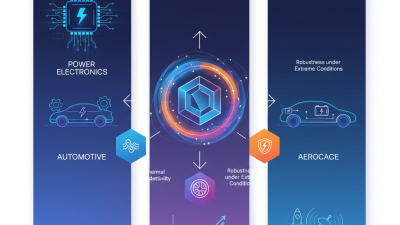
Silicon carbide (SiC) semiconductors are transforming multiple industries. They are crucial in automotive, telecommunications, and renewable energy sectors. For instance, in electric vehicles (EVs), SiC devices enhance efficiency and reduce energy loss. A recent market study predicts that the SiC semiconductor market will grow to $3.7 billion by 2025, driven by these applications.
In the renewable energy sector, SiC semiconductors support solar inverters and wind turbines. They enable systems to operate efficiently under harsh conditions. This results in improved energy conversion rates. A report by Frost & Sullivan highlights that SiC technology boosts inverter efficiency by up to 30%. Moreover, these semiconductors can withstand higher voltages, making them ideal for high-power applications.
When selecting SiC semiconductors, consider thermal management. They generate less heat compared to traditional silicon devices, thus requiring different cooling strategies. Evaluate the operational environment as well. Ensure that the chosen semiconductor aligns with your application requirements. Not all SiC semiconductors are created equally. Testing your specific application is essential for optimal performance.
Applications of Silicon Carbide Semiconductors in Various Industries
Performance Metrics to Evaluate for Optimal Silicon Carbide Selection
When selecting a silicon carbide (SiC) semiconductor, focusing on performance metrics is crucial. Key parameters include thermal conductivity, switching speed, and breakdown voltage. These factors directly impact efficiency and reliability in various applications. For instance, SiC has a thermal conductivity of about 3.4 W/m·K. This property ensures better heat dissipation, making it suitable for high-power applications.
Switching speed is another critical metric. SiC devices can switch faster than traditional silicon counterparts. According to recent reports, SiC semiconductors can achieve rise and fall times in the nanosecond range. This rapid switching leads to reduced energy losses. Consequently, this translates to higher overall system efficiency.
Breakdown voltage is significant, too. SiC can handle voltages up to 1,200 volts or more. This capability allows for operation in high-voltage scenarios, which is essential in industries like automotive and renewable energy. However, one must consider potential trade-offs, such as higher initial costs compared to silicon. Evaluating these performance metrics will ensure that the selected SiC semiconductor meets specific application requirements effectively.
Comparing Silicon Carbide with Other Semiconductor Materials
When choosing semiconductor materials, Silicon Carbide (SiC) stands out for its superior properties. It excels compared to traditional materials like silicon and gallium arsenide. SiC supports higher temperatures and voltages. This makes it perfect for high-power applications. However, it also comes with challenges. SiC is harder to work with and more expensive than silicon.
Tips: Consider your application needs first. Do you require high efficiency or durability? Also, analyze your budget constraints. SiC may save costs in energy over time, but initial investment is higher.
Moreover, the switching speed of SiC devices is impressive. This results in more efficient energy conversion. On the flip side, design and fabrication can be complex. It's important to work with experienced professionals. They can help you avoid pitfalls during integration.
Tips: Research suppliers and their expertise in SiC technology. Look for trusted sources and case studies. Understand the long-term benefits versus immediate costs. Proper evaluation can lead to better performance in your project.